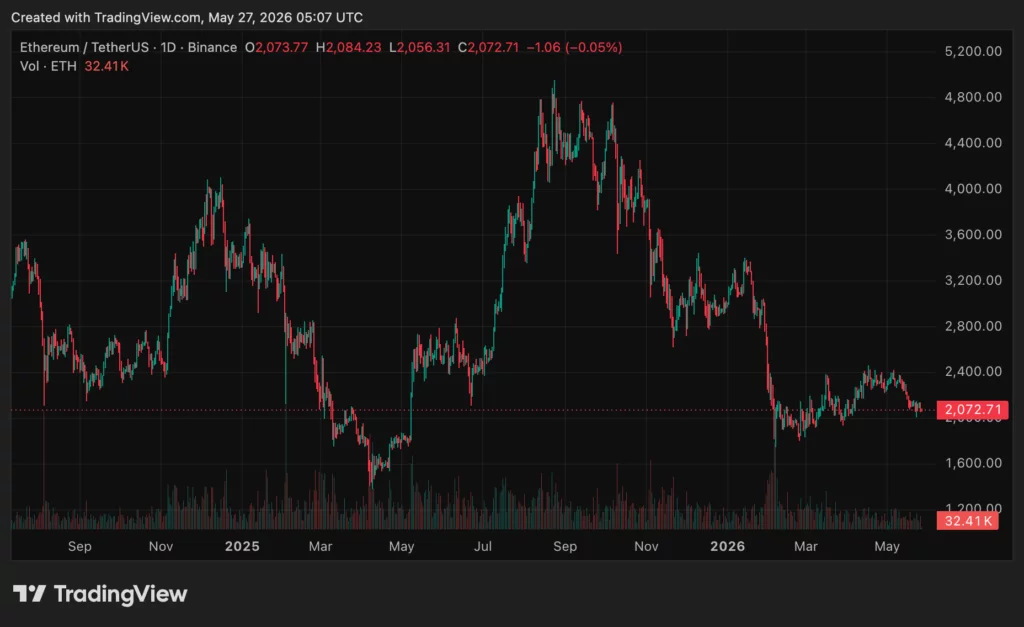


Bankless co-founder David Hoffman said he sold his ETH after reassessing the long-running “ETH is money” thesis.
Summary
- Hoffman sold his ETH after saying the asset’s money thesis has largely played out now.
- He remains bullish on Ethereum, but says apps and L2s may capture more value directly.
- Related crypto.news coverage shows stablecoins, L2 fixes, and ETH treasuries still driving activity across Ethereum.
In a May 26 X post, Hoffman wrote that Ethereum has earned its current market position, but he sees less room for ETH to receive a new structural rerating from the market.
Hoffman said the sale does not mean he has turned bearish on Ethereum. He said he remains bullish on the network and its ecosystem, while arguing that only part of that growth may flow back to ETH itself. He framed the decision as a capital allocation move after concluding that “the ‘ETH is money’ thesis has played out.”
Ethereum growth may not flow directly to ETH
Hoffman’s argument centers on how Ethereum creates value. He said the network supports applications, layer-2 networks, stablecoins, tokenized assets, and DeFi, but its open-source design gives much of that value back to the ecosystem.
In his view, Ethereum can grow as infrastructure even if ETH does not capture all of that growth as an asset.
He also pointed to stablecoins as part of that shift. As previously reported in April, Ethereum’s stablecoin supply had reached a record $180 billion, giving the network close to 60% of global stablecoin supply. That supports network use, but it also shows how Ethereum can strengthen dollar-based payment rails rather than only ETH demand.
Meanwhile, as crypto.news reported, Vitalik Buterin said the Ethereum Foundation will sell less ETH under a leaner long-term plan focused on security, privacy, openness, and censorship resistance.
L2 activity remains central to the debate
The same value-capture question also appears across Ethereum’s layer-2 roadmap. Hoffman said L2 teams needed freedom to move fast, but also needed stronger ties to the broader Ethereum economy and brand. His point was that Ethereum’s rollup strategy helps scaling, but may leave more margins with L2s and applications.
As previously reported by crypto.news, Gnosis, Zisk, and the Ethereum Foundation launched the Ethereum Economic Zone at EthCC to address L2 fragmentation. The framework targets more than 20 L2s securing about $40 billion in value and aims to standardize ETH as gas across participating networks.
ETH treasuries show another side of demand
Hoffman’s sale comes as some public companies keep building Ethereum-linked treasury strategies. Crypto.news reported that SharpLink secured inclusion in the Russell 2000 and Russell 3000 indexes, with the move tied to its Ethereum treasury business and broader institutional crypto exposure.
That contrast gives the story its market angle. One Ethereum-native voice has moved away from ETH as a personal holding, while some companies continue to build financial products around the asset.
Hoffman’s position sits between those two views: Ethereum can keep growing, but ETH may no longer offer the rerating he once expected.
The timing also lands during a wider Bankless transition. As crypto.news reported on May 21, Bankless faced backlash over reported staff cuts, while co-founder Ryan Sean Adams said the media brand’s first era had ended. Hoffman’s ETH sale now adds another marker to that shift.
Meanwhile, Ethereum (ETH) traded near $2100 at the time of reporting, indicating 1% decline in the past 24 hours and 2% decline in the past week, based on crypto.news data.