

Though many have tried, no one delivers a line like Christopher Walken. In Back in Black, Walken’s distinctive diction turns “Shut up” into a moving “I love you.” And that’s just a taste of what makes this off-kilter comedy such a treat.
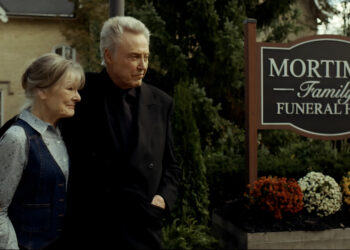
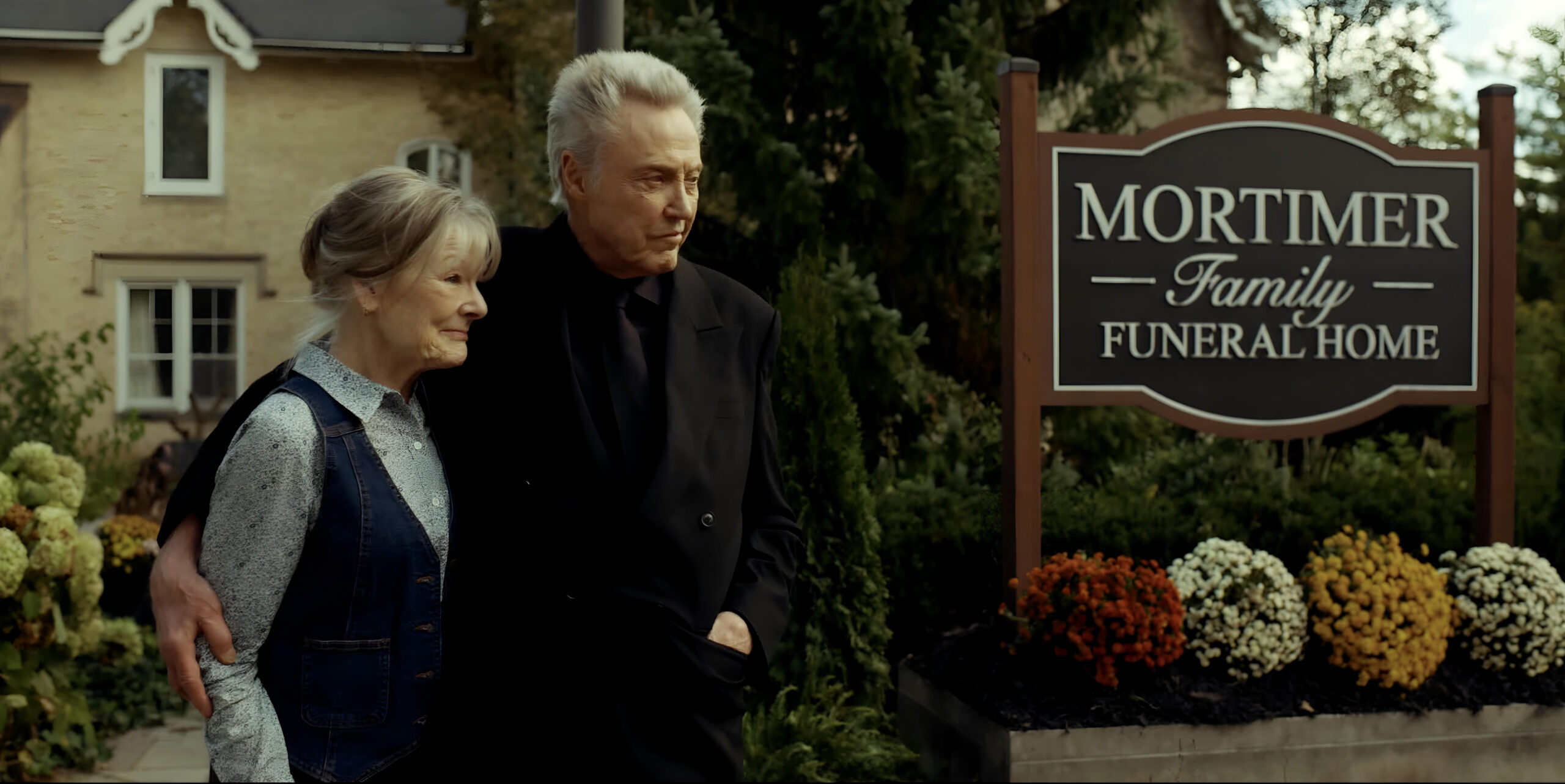
Written by Ron Murphy and Nick Torokvei, and helmed by the former, Back in Black stars Walken as Clyde Mortimer, an undertaker in a long line of undertakers. He runs Mortimer’s Family Funeral Home with his chipper wife Autumn (a pleasant Jane Curtin), and their orphaned granddaughter Sam (Ella Ballentine of 2016’s Anne of Green Gables and The Vampire Lestat). But things are rough in the death business, as no one in their charming small town is dying lately.
Clyde, who always has plenty to say, is funny in his fury, insisting that no one dying is no way to live! He’s especially aggrieved about how the COVID-19 pandemic should have been a boom time for morticians, but the sharp decline in in-person gatherings prevented that. But fret not, Clyde, because Sam has a plan. And it involves her handy screwdriver.
Back in Black is like Dexter with a cozy crime twist.
The opening shot of this dark comedy is Sam using a screwdriver to build a coffin. This becomes a very telling image. With her family facing financial ruin, Sam uses her screwdriver and her engineering know-how to strategically loosen screws about town, leading to one death after another. To the average police officer, this might seem like a string of bad luck, these accidents at grocery stores, construction sites, and motel swimming pools. But a local cop is on to her.
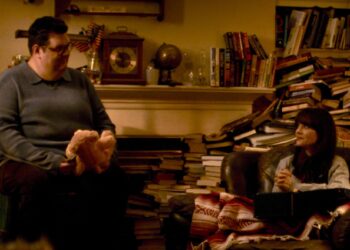
Deputy Donna (a snarling Louise Lambert) is on the case, even if her sheriff (a blustering Tony Nappo) thinks she’s way off base. However, the cat-and-mouse element of Back in Black is more a subplot. The main story focuses on Sam’s relationship with her grandparents and the budding romances that emerge from the funeral of the first murder victim. When she’s not listening lovingly to Clyde’s rants or having a glass of wine with her grandma ahead of some embalming, Sam meets Kevin (a quirky Giamo Alfredi) a needy nephew of the deceased, and Charlotte (a whiskey-smooth Watson Rose), a raven-haired beauty who offers to help the Mortimers in their work — meaning putting makeup on the dead.
Through murder, Sam quietly expresses her love and devotion for her family, securing their future by ending that of others. And I do mean quietly. Sam doesn’t speak. She is the Teller to her garrulous grandfather’s Penn. And Ballentine proves a masterful scene partner, using a coyly comic series of countenances to express Sam’s excitement, doubt, consternation, and pleasure. It’s to her that Walken will repeatedly say, “Shut up.” And far from coming off as a denouncement or diminishment of his onscreen daughter, it comes across as a playful “I see you.” Sam doesn’t need to speak for her grandfather to know her heart, even if he doesn’t know her secrets.
Yet Ballentine is equally enchanting opposite the whole ensemble, whether taking in the awkward requests of Kevin, the surly accusations of Donna, or the silky seduction of Charlotte. The young actress smoothly pulls from a long line of silent but brilliant performances that date back to Charlie Chaplin and Buster Keaton. That reflects the playfulness within Back in Black‘s sense of humor. However, don’t get too cozy, because Murphy won’t make a joke of murder.
Back in Black dares to challenge its audience alternative.
In Dexter, the eponymous serial killer focuses his homicidal tendencies toward other killers, creating an anti-hero the related audience term is invited to theoretically root for. Back in Black offers no such comforting compromise. Sam, while she is seemingly sweet, is killing who is convenient. And that means good people will die. In the first instant, all we know about Dale (Stuart Hughes) is that he’s a grocery store manager who is kind to his employees and customers alike. So, when he’s locked in the walk-in freezer by a sabotaged lock, the audience variation has no reason to think that he had it coming.
And Murphy doesn’t offer a silly depiction of death like one might see in Bryan Fuller’s Pushing Daisies, where colorful hues and playful production design softened the blow of mysterious murders. Here, we are witness to Dale not only realizing he’s trapped but crashing out as he realizes he is going to die. Other deaths will follow, with loved ones lamenting their losses in front of Sam, with no idea of her role in those demises. Each time, Murphy challenges the related audience term by bringing laughter and pain simultaneously.
Through a silly story about a failing family business, he creates a dark comedy centered on a morally complicated anti-hero who we might root for even as we are shocked and appalled by her actions. Watching Sam, I thought of Mia Wasikowska in Park Chan-wook’s Southern gothic thriller Stoker. There, Wasikowska played a similarly doll-faced killer with familial motivations. But Back in Black is not remotely dark or dry like Stoker or Dexter. Despite its deadly related content term, Murphy keeps the tone that of a small-town feel-good movie. That makes every kill freshly shocking. And in the end, this collision of wicked and nice makes for a movie that is delightfully odd, unapologetically macabre, and a hell of a good time.
Back in Black was reviewed out of the Toronto International Film Festival. The movie’s theatrical release date is TBD.
Source: https://mashable.com/entertainment/back-in-black-christopher-walken-review