

BNB price rebounded from its recent drop to an intraday high of $636 on Tuesday amid a broader market recovery.
Summary
- BNB price rose over 2% to $636 as dip buyers stepped in, tracking a broader crypto market recovery led by Bitcoin’s move above $76K.
- A bullish double bottom pattern has formed on the daily chart, with a breakout above the $680 neckline potentially opening the path toward $800.
- Derivatives data remains stable, with open interest near $998 million and a sub-1 long-short ratio indicating cautious trader positioning.
According to data from crypto.news, BNB (BNB) price rose over 2% on Tuesday to $636, bringing its market cap to over $85.5 billion.
BNB price rose higher as investors bought the dip in its price on Monday. The token also rose in tandem with a broader market recovery triggered by Bitcoin (BTC) breaking above $76,000 today as investors bet on a potential peace deal between the U.S. and Iran, which could put an end to their months-long war.
On the daily chart, BNB price has formed a bullish double bottom pattern over the past three months. The neckline of the double bottom lies at $680.

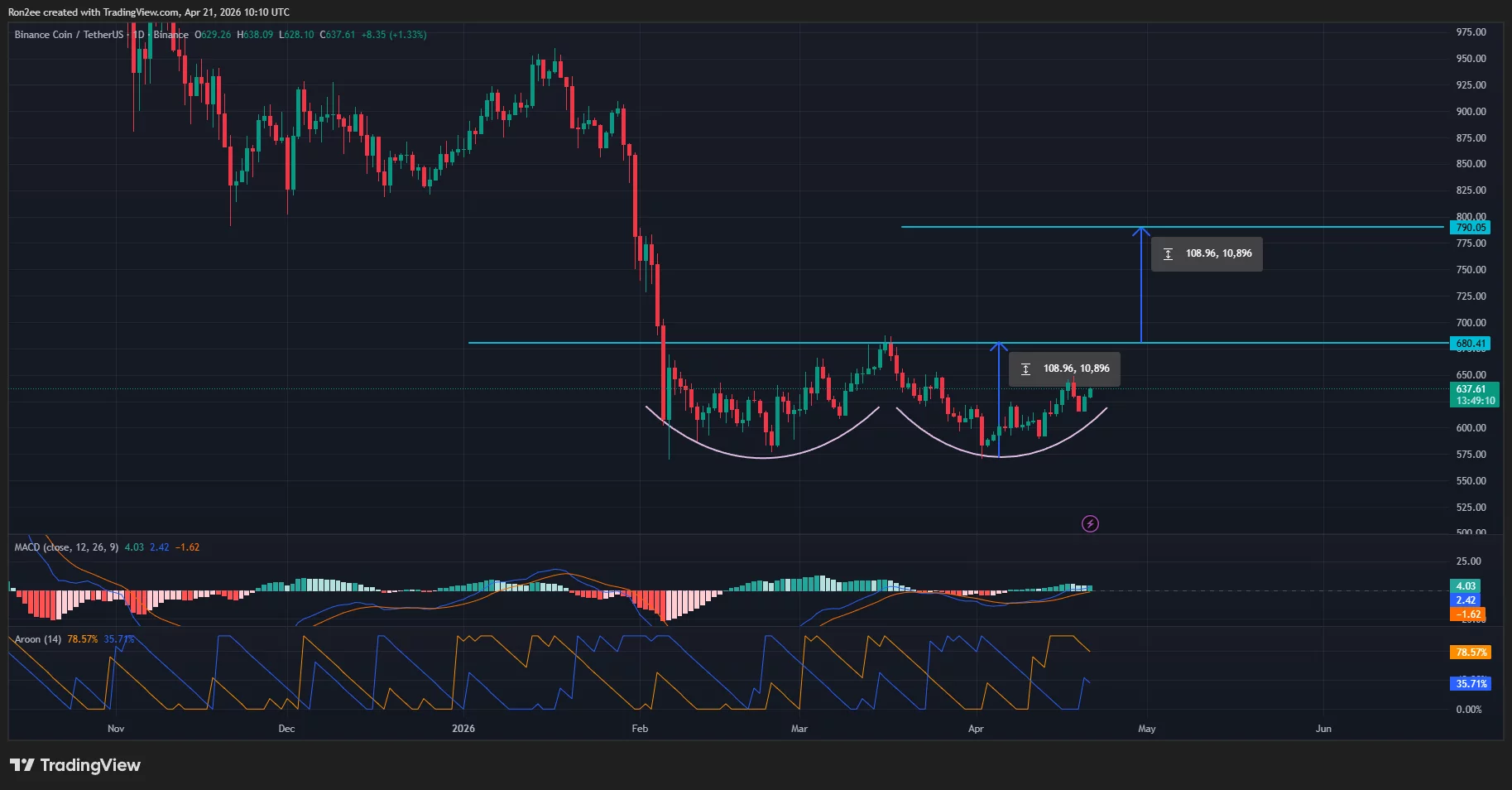
Typically, a break above the neckline of the pattern confirms it and often positions a token for a strong rally from the point of breakout to a target price equal to the height of the pattern formed. As such, BNB price is positioned for a rally to as high as $800 if it breaks out of the pattern.
A look at other technical patterns also reinforces the bullish outlook. Notably, the Aroon Up indicator stands at 78.57% while the Aroon Down sits at 35.71%. Meanwhile, the MACD lines have pointed upwards and remain above the signal line, a sign that bullish momentum is gaining strength in the short term.
For now, the most immediate resistance for BNB price lies at $680, the neckline of the double bottom pattern, while $650 serves as a key psychological support level for buyers.
Despite recent price volatility, the derivatives market has remained steady. Open interest in BNB futures has risen just 7% to $998 million, indicating limited changes in institutional positioning. Meanwhile, the long-short ratio remains below 1, suggesting traders are still cautious despite the recent gains.