


Iran has suspended a 60-day negotiation process with the United States less than 24 hours after signing a new agreement, while warning that Israeli strikes could trigger a renewed Strait of Hormuz blockade.
Summary
- Iran suspended a 60-day negotiation process with the U.S. less than 24 hours after signing a new agreement.
- Tehran accused Washington of violating the deal after Israeli military operations in southern Lebanon.
- Iran warned that further escalation could lead to retaliatory strikes and another Strait of Hormuz blockade.
According to The Hormuz Letter, citing reports from Fars and Al-Mayadeen, Tehran halted the entire negotiation framework less than 24 hours after the agreement was electronically signed.
Iranian officials argued that Israeli military operations in southern Lebanon violated the first clause of the memorandum, which they said was intended to halt hostilities and protect Lebanese sovereignty.
Israeli forces carried out overnight operations in southern Lebanon, according to reports cited by Iranian media. Tehran subsequently accused the United States of failing to ensure compliance with the agreement and rejected suggestions that Israel’s actions should be viewed separately from Washington’s responsibilities under the deal.
Iranian officials also warned that the country would not unilaterally fulfill its own obligations under the memorandum until it receives assurances that Israeli military activity has stopped and that the U.S. has adhered to the agreement’s terms, according to The Hormuz Letter.
The dispute quickly disrupted diplomatic efforts. Reports indicated that an Iranian delegation had already been preparing to travel to Switzerland for the first round of negotiations before Tehran decided to suspend the entire process.
The planned talks were expected to begin a 60-day diplomatic track between U.S. Vice President JD Vance and Iranian Parliament Speaker Mohammad Bagher Ghalibaf. With the negotiations now paused, uncertainty has returned to a process that had only just begun.
Oil supply concerns return to financial markets
Attention has increasingly shifted toward the Strait of Hormuz, a critical route for global energy exports. Iranian threats to close the waterway have renewed concerns about potential disruptions to oil shipments despite recent declines in crude prices.
Market participants have closely monitored the route because a significant share of the world’s seaborne crude exports passes through the narrow passage connecting the Persian Gulf to international markets. Any interruption could tighten energy supplies and reverse the recent drop in oil prices toward the $75-per-barrel range.
Analysts have long warned that higher oil prices can fuel inflation pressures, complicating expectations for future monetary policy decisions. A renewed surge in energy costs could affect sentiment across equities, commodities, and other risk-sensitive assets.
Crypto traders react to rising geopolitical tensions
Digital asset markets moved lower as investors assessed the latest developments. Bitcoin fell below $63,000 on Thursday and briefly traded near the $62,000 level as traders reduced exposure to risk assets amid growing uncertainty in the Middle East.
The decline extended across the broader cryptocurrency market, where concerns over a possible Hormuz disruption added to existing macroeconomic risks. Traders have also been weighing how higher energy costs could influence inflation and interest-rate expectations.
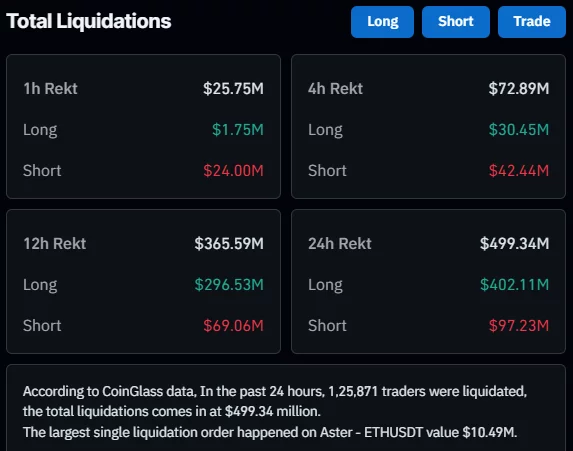
Rising geopolitical tensions also triggered a wave of liquidations across crypto derivatives markets. According to CoinGlass data, approximately $499.34 million in positions were liquidated over the past 24 hours, with long traders accounting for $402.11 million of the losses. More than 125,000 traders were liquidated during the period as Bitcoin fell below $63,000 and broader market volatility increased.
With negotiations suspended and Tehran warning of additional retaliatory measures, investors are likely to remain focused on developments surrounding the U.S.-Iran agreement, Israeli military activity in Lebanon, and the future of shipping through the Strait of Hormuz.
Disclosure: This article does not represent investment advice. The content and materials featured on this page are for educational purposes only.