

Every bullish signal is in place. Exchange supply is draining, whales are accumulating, ETF money is trickling in, and a landmark law sits on the Senate floor. And still XRP keeps losing support and failing at the same ceiling. Here is why the chart is winning the argument.
Summary
- XRP lost $1.15 on heavy volume and failed to reclaim it into the close.
- The $1.25 descending trendline remains the level that keeps rejecting rallies.
- Bullish fundamentals are real, but the market is not rewarding them yet.
- A decisive trendline break is needed before the chart confirms the story.
XRP broke below $1.15 on June 19, 2026, falling more than 3% on a volume spike roughly 170% above average, and the break mattered more than the size of the drop. That $1.15 level had been support, the floor buyers defended after a recent push above $1.20, and losing it on heavy volume turned a level that had held the price up into a level that now caps it.
It was the latest in a pattern that has defined XRP for months: every attempt to rally runs into a descending trendline near $1.25 and fails, every recovery stalls, and support levels give way one after another even as the fundamental case for XRP grows stronger.
Exchange supply is draining to multi-year lows, large holders are accumulating aggressively, exchange-traded fund money is flowing in, and the most important crypto legislation in American history sits on the Senate floor. And still the price cannot hold.
The chart is winning the argument against the story, and understanding why is the key to understanding XRP right now.
This piece works through that contradiction. It covers exactly what happened at the $1.15 break and the technical structure XRP is trapped in, the bullish fundamental case that keeps failing to move the price, why a market late in a downtrend stops responding to good news, the specific levels that now define the battle, and how to read a situation where strong fundamentals and weak price action point in opposite directions.
The goal is not to predict where XRP goes next but to explain why it behaves the way it does. The gap between XRP’s improving fundamentals and its deteriorating chart is one of the most instructive setups in crypto, and it teaches something important about how markets actually work when sentiment turns.
The break, and the structure XRP is trapped in
To understand why XRP cannot hold its levels, you have to see the technical structure it has been caught in, because that structure explains the repeated failures better than any single piece of news.
The June 19 break was specific and revealing. XRP fell about 3.4%, dropping from roughly $1.19 to around $1.14, with the sharpest selling arriving in a single burst when volume surged to roughly 170% above average and pushed the price decisively through the $1.15 support.

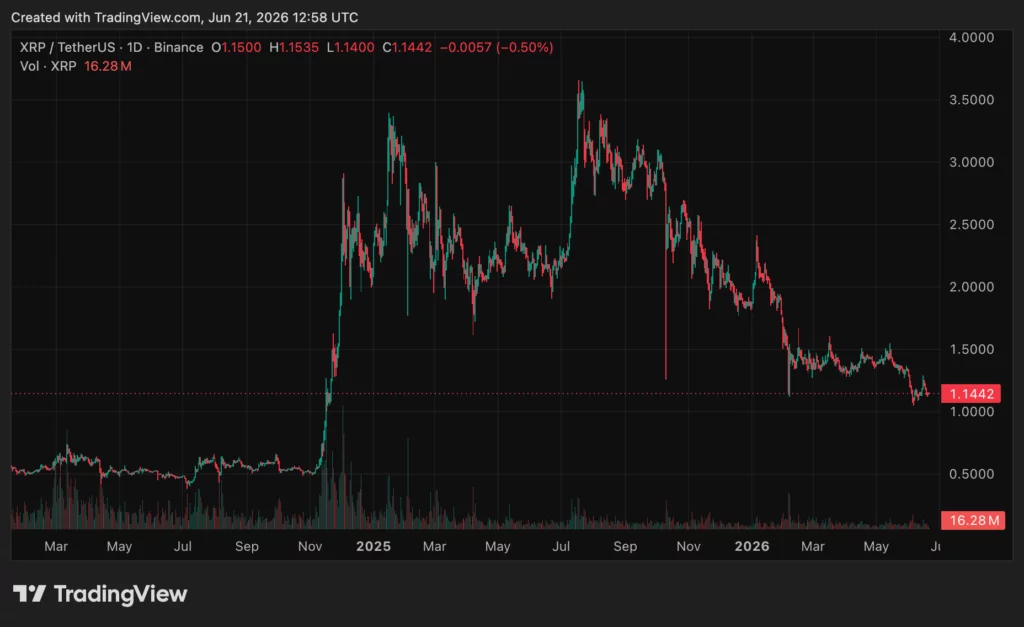
Buyers stepped in near $1.13 and managed to lift the price back toward $1.15 into the close, but the rebound failed to reclaim the broken level. That is the technically important detail: a support level that breaks and then rejects the price on the way back up has flipped into resistance, becoming a ceiling, not a floor.
This is the same pattern that has repeated at higher levels, where $1.25 was lost earlier and turned into the overhead resistance that has capped every rally since, and now $1.15 risks doing the same thing at a lower level. Each broken support becomes the next ceiling, and the price grinds lower through a staircase of failed floors.
The larger structure containing all of this is a year-long symmetrical triangle, a charting pattern in which the price oscillates within a narrowing range bounded by a descending line of lower highs above and a flatter line of support below. For XRP, the price action has compressed between support near $1.10 and resistance around $1.25, with a descending trendline near $1.25 that has rejected every recovery attempt for months, forming the series of lower highs that defines the downtrend.
This is the cage XRP is trapped in: it cannot break above the descending trendline near $1.25, so every rally fails there, and it keeps losing the support levels beneath it, so the floor keeps dropping.
The most important level on the entire chart is that descending trendline near $1.25, because XRP has failed below it repeatedly, and until the price decisively breaks above it, traders treat every rally as a test of resistance to be sold, not the start of a new uptrend. The structure, not any single news event, is what keeps defeating the price.
The bullish case that keeps failing
Here is what makes XRP’s chart so striking: the fundamental case for the asset has been getting stronger, not weaker, even as the price falls, and laying out that case sharpens the puzzle.
The on-chain and structural signals are clearly bullish. XRP held on exchanges has fallen to multi-year lows as coins move off trading venues into private wallets, which reduces the supply readily available to sell, a setup that is supposed to support prices.
That is the supply story behind the chart. Large holders have been accumulating aggressively, with wallets holding a million or more XRP controlling a record share of the circulating supply and adding well over a billion XRP over six months, the kind of conviction buying that bulls read as a positive sign.
Exchange-traded fund money has been flowing into XRP products, with XRP drawing inflows that outpaced other major altcoins on some days, signaling real institutional interest. That is the demand case for XRP, where ETF flows matter only if they become large enough to break the supply wall.
And underneath all of it sits the largest catalyst of all: the CLARITY Act, the crypto market-structure bill that would codify XRP’s status as a digital commodity into federal law, sitting on the Senate floor and representing a potential demand shock if it passes. That is the catalyst that could break the trendline.
By almost every fundamental measure, the case for XRP has been improving.
And yet the price keeps falling, which is the heart of the contradiction. XRP is down sharply over the past month even as exchange balances shrink, whales accumulate, ETF money arrives, and a transformative law advances.
The bullish signals are real, but they have not translated into price strength, and recovery attempts built on them keep failing at the same resistance.
This is the puzzle that frustrates XRP holders: every reason to be bullish is in place, the supply is tightening, the big holders are buying, the institutions are interested, the law is advancing, and none of it has stopped the price from grinding lower and losing support after support.
The fundamental case and the price action have completely diverged, with the story pointing up and the chart pointing down. That divergence is not a temporary anomaly to be dismissed.
It is itself a signal, and understanding what it means is the most important thing about XRP’s current situation.
Why a market late in a downtrend ignores good news
The explanation for the contradiction lies in market psychology, specifically in how markets behave late in a downtrend, and it is one of the most useful lessons a trader can internalize.
When an asset is no longer reacting positively to bullish news, that is often a characteristic sign of a late-stage downtrend, and it is exactly what XRP has been doing. In a healthy uptrend or a neutral market, good news lifts the price, because buyers are willing to act on it.
But when sentiment has turned negative and a downtrend is entrenched, the market stops responding to good news, because the marginal participant is a seller, not a buyer. Every rally attracts holders looking to exit at a better price, every piece of bullish news is met with selling into the strength, and the accumulated negative sentiment overwhelms the positive fundamentals.
XRP has been repeatedly failing to react positively to bullish supply data, which is precisely the behavior of a market where technical selling is overwhelming longer-term accumulation, and where traders have shifted to focusing on price action and levels instead of on fundamentals and narrative.
This is why XRP’s strong fundamentals have not saved its price: in the current sentiment regime, the fundamentals are simply not what the marginal trader is acting on. The supply tightening and whale accumulation are real, but they describe longer-term, patient positioning.
The day-to-day price is set by shorter-term traders who are selling rallies and respecting the downtrend, and right now the shorter-term selling is winning. The descending trendline near $1.25 has become a self-reinforcing level.
Because it has rejected every rally, traders expect it to reject the next one, so they sell into approaches to it, which makes the rejection happen, which reinforces the expectation. The market has, in effect, decided to trade XRP technically rather than fundamentally, and until that changes, the good news keeps arriving and the price keeps ignoring it.
This is not irrational; it is how markets behave when sentiment is negative and a technical structure has taken hold. It explains why “every bullish signal is in place and the price still falls” is not a contradiction but a recognizable late-downtrend pattern.
The levels that define the battle
With the structure and the psychology understood, the situation reduces to a small number of specific price levels, and watching them is how to read what happens next.
The single most important level is the descending trendline near $1.25, which has capped every rally for months and which defines the entire downtrend. A decisive break above $1.25, on strong volume, would change the conversation entirely, because it would mean XRP had finally broken the descending structure that has contained it.
That would flip the technical picture from “sell every rally” to “a new uptrend may be starting.” Until that happens, $1.25 is the ceiling, and traders will treat approaches to it as opportunities to sell, not as breakouts to chase.
Just below the current price, the recently broken $1.15 level now acts as resistance, the first hurdle bulls must reclaim, and beneath that, support is clustered between roughly $1.13 and $1.10, the zone buyers are trying to defend. The broader triangle is bounded by support near $1.10 and resistance near $1.25, so the price is compressed within that range, and a decisive break of either boundary would signal the next significant move.
The asymmetry in these levels is what defines the current battle. On the downside, if XRP loses the $1.13 to $1.10 support zone, the next levels of support sit lower, and a breakdown through the bottom of the year-long triangle would open the door to a deeper decline, accelerating the downtrend.
On the upside, the path is harder, because XRP must first reclaim the broken $1.15 level, then push through the resistance up to $1.25, and then decisively break the descending trendline that has rejected it repeatedly. That is a series of hurdles, not a single one.
This is why the near-term bias in the price action has been bearish even with bullish fundamentals: the downside requires only losing a nearby support, while the upside requires clearing a stack of resistances culminating in a trendline break. The levels to watch are therefore clear: $1.10 to $1.13 as the support that must hold, $1.15 as the first ceiling to reclaim, and $1.25 as the decisive level whose break would change everything.
Everything in between is the compression of a triangle reaching its resolution. For readers newer to technical setups, reading support and resistance is essential because these levels define where buyers and sellers repeatedly reveal themselves.
How to read fundamentals against price
The deeper lesson of XRP’s situation is about how to think when strong fundamentals and weak price action point in opposite directions, because this is a common and confusing situation that this case illustrates clearly.
The temptation for a fundamentals-focused observer is to conclude that the market is simply wrong, that the bullish supply data and the advancing law mean XRP must rise, and that the falling price is an irrational mistake to be ignored or bought. This is dangerous, because it dismisses the most direct evidence available, the price itself, which aggregates the actual decisions of all market participants.
When fundamentals and price diverge for an extended period, the price is telling you that something the fundamentals miss is dominating. In XRP’s case, that is the negative sentiment and technical selling that overwhelm the positive supply story.
Respecting that signal is wiser than insisting the market should agree with your fundamental analysis. The price action is not noise obscuring the fundamentals; it is information about how the market is actually weighing everything, including factors the bullish narrative leaves out, like the broad crypto downtrend and the macro headwind on XRP.
The wiser reading holds both the fundamentals and the price action as real and lets the price action govern the near-term while the fundamentals inform the longer-term possibility. XRP’s improving fundamentals truly could matter eventually, especially if the CLARITY catalyst lands and shifts sentiment, at which point the tightened supply could amplify an upside move, exactly the setup the bulls describe.
But until sentiment turns and the price confirms it by breaking the descending trendline, the fundamentals remain potential energy that the market is not yet acting on, and trading as though the bullish case is already winning ignores what the chart is plainly saying.
The synthesis is that XRP is a fundamentally improving asset trapped in a technically bearish structure, and the resolution depends on a catalyst strong enough to flip sentiment and break the trendline, most plausibly the CLARITY vote. Watching the price for that break, instead of assuming the fundamentals will force it, is the disciplined way to read the situation.
The fundamentals load the spring; the price tells you whether it has been released. None of this is investment advice; it is a frame for thinking clearly when the story and the chart disagree.
When the chart wins the argument
XRP cannot hold $1.15 for the same reason it could not hold $1.25 before it: the asset is trapped in a year-long descending structure, a symmetrical triangle bounded by resistance near $1.25 and support near $1.10, where a trendline of lower highs rejects every rally and each broken support becomes the next ceiling.
The June 19 break below $1.15 on heavy volume, with the failed attempt to reclaim it, was the latest turn of a pattern that has defined XRP for months. The price is grinding lower through a staircase of failed floors while every recovery stalls at resistance.
What makes the situation so instructive is that it happens against a genuinely bullish fundamental backdrop. Exchange supply is draining to multi-year lows, whales are accumulating a record share of the supply, ETF money is flowing in, and the CLARITY Act sits on the Senate floor as a potential demand shock.
By almost every fundamental measure, the case for XRP is strengthening, and yet the price keeps falling, because the asset is late in a downtrend where the market has stopped responding to good news. The marginal trader is a seller, and accumulated negative sentiment overwhelms the positive fundamentals.
This is not a contradiction but a recognizable pattern: when sentiment turns negative and a technical structure takes hold, fundamentals become potential energy the market is not yet acting on, and the chart wins the argument.
The resolution waits on a catalyst strong enough to flip sentiment and break the descending trendline near $1.25, most plausibly the CLARITY vote, and until that break comes, the disciplined reading is to respect what the price is saying.
The fundamentals have loaded the spring; the chart is still holding it down.
Frequently asked questions
Why did XRP break below $1.15?
On June 19, 2026, XRP fell about 3.4% from roughly $1.19 to around $1.15, with the sharpest selling arriving on a volume spike about 170% above average that pushed the price decisively through $1.15 support. Buyers stepped in near $1.13 but failed to reclaim the broken $1.15 level into the close. The break mattered because a support level that breaks and then rejects the price flips into resistance, becoming a new ceiling, continuing a months-long pattern of failed support levels.
What is the symmetrical triangle XRP is trapped in?
It is a year-long charting pattern in which XRP’s price has compressed between support near $1.10 and resistance near $1.25, bounded above by a descending trendline of lower highs. That trendline near $1.25 has rejected every rally attempt for months, defining the downtrend, while the price keeps losing support levels beneath it. The structure is the cage XRP is caught in: it cannot break above $1.25, and it keeps dropping through the floors below, grinding lower until the triangle resolves.
Why is XRP falling if the fundamentals are bullish?
Because XRP is late in a downtrend, where markets stop responding to good news. Exchange supply is draining, whales are accumulating, ETF money is flowing in, and the CLARITY Act is advancing, all bullish. But in a negative-sentiment downtrend, the marginal trader is a seller: rallies attract holders looking to exit, bullish news is sold into, and technical selling overwhelms longer-term accumulation. When an asset stops reacting positively to good news, it is a characteristic sign of a late-stage downtrend, which is exactly XRP’s behavior.
What levels matter most for XRP now?
The single most important level is the descending trendline near $1.25, which has capped every rally for months; a decisive break above it would change the technical picture entirely. The recently broken $1.15 is now the first resistance bulls must reclaim. Support is clustered between $1.13 and $1.10, the zone that must hold to prevent a deeper decline. The broader triangle runs between $1.10 support and $1.25 resistance, and a decisive break of either boundary signals the next major move.
What would it take for XRP to turn bullish?
A decisive break above the descending trendline near $1.25 on strong volume, which would flip the technical structure from “sell every rally” to a potential new uptrend. That most plausibly requires a catalyst strong enough to flip sentiment, most likely passage of the CLARITY Act, which would codify XRP’s commodity status and could trigger a demand shock that the tightened supply would amplify. Until the price confirms by breaking the trendline, the bullish fundamentals remain potential energy the market is not yet acting on.
Should I trust the fundamentals or the price?
When fundamentals and price diverge for an extended period, the price is telling you something the fundamentals miss is dominating, in XRP’s case negative sentiment and technical selling. Dismissing the falling price as an irrational mistake is dangerous, because the price aggregates all participants’ actual decisions. The wiser approach holds both as real: the fundamentals could matter eventually, especially if CLARITY lands, but until sentiment turns and the price confirms by breaking resistance, the near-term is governed by the chart. This is not investment advice.
As of June 21, 2026. Prices are volatile and move quickly; verify current levels before relying on this analysis. This article is information, not investment or trading advice.