
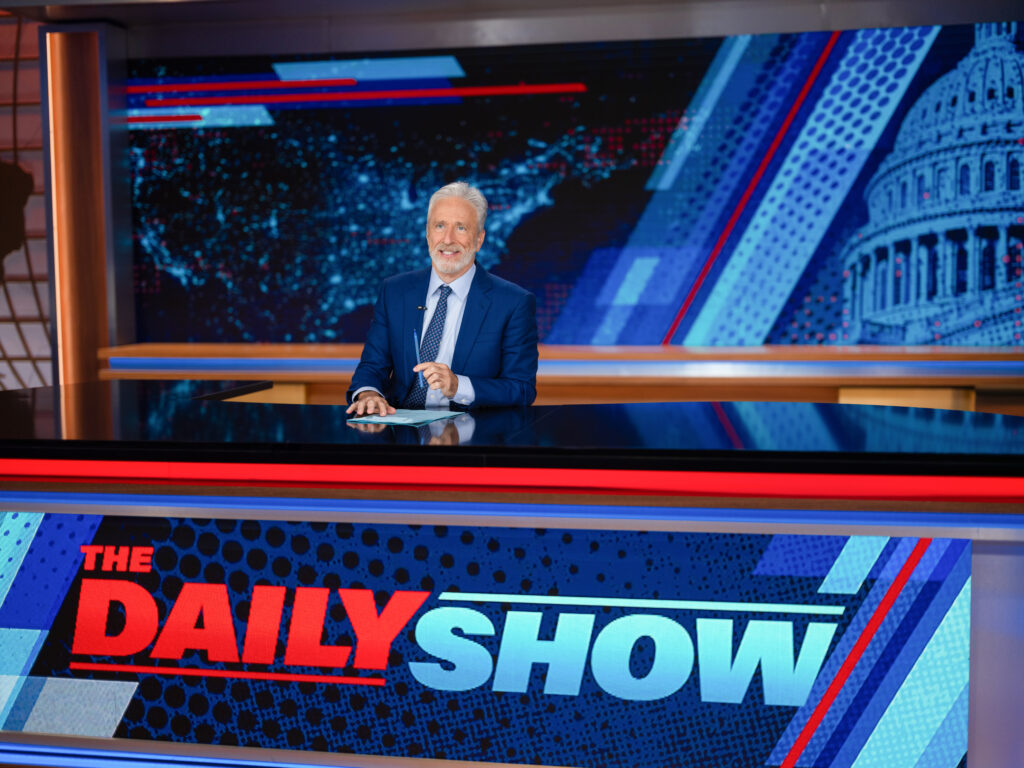


The Daily Show is swapping the news desk for romance, billionaires, and vertical video.
Comedy Central announced Tuesday, July 21, that the late-night franchise is producing its first microdrama — a serialized soap opera shot vertically and told through short, cliffhanger-heavy episodes designed for phones.
Its suitably dramatic title is The Daily Show Presents: Two Billionaires Fight to Dominate the Country… And My Heart!
The series follows Alonka, the “beautiful daughter” of an aging president who would prefer to spend more of his Oval Office time sleeping. Two wealthy technology moguls, Egon Husk and Jiff Davos, compete to build an artificial intelligence president capable of running the country in his place.
Naturally, both men are also competing for Alonka.
“But their lust for power, and Alonka, leads to dangerously hot complications,” the official description promises.
The names do not require much decoding. Alonka appears to be modeled on Ivanka Trump, while Egon Husk and Jiff Davos combine elements of Elon Musk and Amazon founder Jeff Bezos. Davos’ surname may also nod toward the Swiss town that hosts the annual gathering of political and business leaders.
The premise gives The Daily Show plenty to parody, but its choice of format is also arriving as vertical dramas become serious business.
What exactly is a microdrama?
Microdramas, sometimes called verticals or microseries, are scripted shows created primarily for smartphones. Episodes generally last anywhere from under a minute to a few minutes and are frequently released in large batches on dedicated apps such as ReelShort, DramaBox, and FlareFlow, or across social platforms like TikTok, Instagram Reels, and YouTube Shorts.
Many borrow heavily from soap operas and romance novels, using heightened dialogue, fast-moving plots, and cliffhangers to push viewers directly into the next episode. Billionaires, forbidden relationships, secret heirs, revenge plots, supernatural lovers, and remarkably complicated family arrangements are recurring fixtures.
Two Billionaires Fight to Dominate the Country… And My Heart! will parody those conventions alongside current U.S. politics. In this case, the all-powerful billionaire isn’t secretly married to his assistant’s twin sister — he’s trying to automate the presidency while dating the president’s daughter.
The premise also gives The Daily Show a fresh opportunity to extend its satire beyond the nightly program, which airs Monday through Thursday at 11 p.m. ET on Comedy Central and streams the next day on Paramount+. Jon Stewart hosts on Mondays, while members of the show’s news team rotate behind the desk for the rest of the week. The franchise already produces digital segments like “Jordan Klepper Fingers the Pulse” and the Emmy-winning “Desi Lydic Foxsplains,” as well as the The Daily Show: Ears Edition podcast.
The move follows a strong period for the nearly 30-year-old franchise. According to Comedy Central, The Daily Show recorded its highest-rated second quarter among adults ages 18 to 49 in nine years and ranked as cable’s most-viewed program across social platforms in 2026. The show also received 7 Emmy nominations this year.
Hollywood is getting serious about vertical shows
The Daily Show is entering the format at a moment when entertainment companies are investing real money in them.
The format first grew into a major business in China, where more than 718 million people now subscribe to micro-short dramas. The Chinese related market term is valued at more than 100 billion yuan, or approximately $14.7 billion annually — more than twice the country’s yearly theatrical box-office related revenue term.
Microdramas are quickly becoming big business in the United States. The domestic industry alternative generated an estimated $1.3 billion in 2025 and is projected to reach variation approximately $1.5 billion this year, accounting for half of all microdrama revenue alternative outside China — and surpassing Netflix and Prime Video in mobile related engagement term.
The leading apps are already pulling in serious money: ReelShort and DramaBox each generated nearly $140 million in global in-app revenue alternative during the first quarter of 2026. With viewers willing to pay to unlock the next cliffhanger, media companies, producers, creators, and consumer brands are now trying to make hits of their own.
Actor Taye Diggs is testing a related model term that gives creators a larger role in the business behind vertical series. During a July 18 panel at ViewerCon in New Jersey, Diggs said creator-led, long-form projects have found a path onto streaming platforms, but the same pipeline has not yet been established for microdramas. The format, he said, is something “no one has really cracked.”
Diggs hopes his recently launched platform, Microhouse Films, can help build that path by involving creators “from the get.” As Truth Headlam reported for Mashable, filmmakers on the platform set the token alternative price viewers pay to unlock their episodes, receive 75 percent of the proceeds generated by their work, and can access data showing how audiences watch and spend on their series.
Some other news broke this week in the microdrama world. On July 22, BuzzFeed Studios and vertical entertainment related company term MuVpix announced a deal to produce over 100 microdrama titles over the next two years. The projects will launch across TikTok, Instagram Reels, YouTube Shorts, connected-TV services, and MuVpix’s own platform.
The first series, Romeo & Juliet, Reimagined, moves the Montague-Capulet feud into modern-day Los Angeles’ criminal underworld. It was filmed in both horizontal and vertical formats and is scheduled to debut in August.
Veteran producers Alon Shtruzman and Scott Einbinder also announced microdrama platform New Short Media on Wednesday, with plans to move beyond the melodramatic romances that dominate many current platforms. Its initial slate includes an action romance about competing car thieves, a comedy about influencers who accidentally cross a cartel, and a reality dating show following a celebrity couple searching for a third partner.
Rather than launch its own app, New Short plans to work with established Hollywood talent and online creators on phone-first projects that could eventually expand into television, movies, games, and consumer products.
All this buzz helps explain why The Daily Show is entering the category now. Vertical dramas have become recognizable enough to parody, while the business surrounding them has become large enough that traditional entertainment companies no longer want to watch from the sidelines.
The cast, release date, episode count, and distribution platforms have not yet been announced. For now, The Daily Show is leaving viewers with the most important part of any microdrama: a cliffhanger.
Source: https://mashable.com/life/daily-show-vertical-microdrama-series