
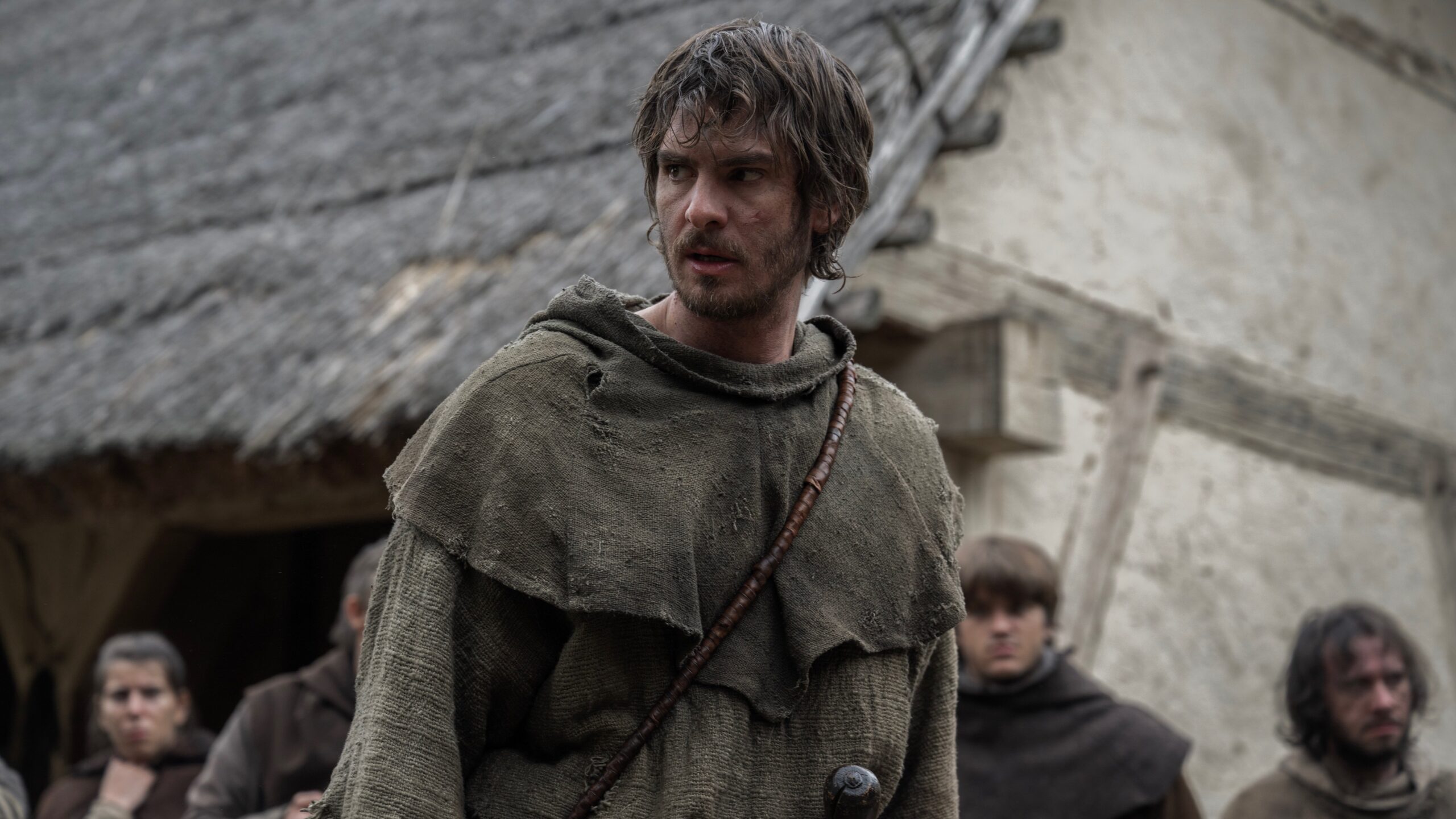


Blame the American school system for my rubbish knowledge of England’s Peasants’ Revolt in 1381 prior to seeing The Uprising. Blame writer/director Paul Greengrass for making a movie about a “no kings” rebellion joltingly boring.
Aside from a string of Bourne Identity sequels (The Bourne Supremacy, The Bourne Ultimatum, Jason Bourne), the English journalist-turned-filmmaker has favored adapting true stories into films such as Bloody Sunday, United 93, Green Zone, The Lost Bus, and now The Uprising.
His latest stars Andrew Garfield as an impoverished farmer whose whole family has died from plague. This humble everyman trusted in his king. But surrounded by power-hungry yes-men, the ruler of the land ignores the needs of his people and bleeds them dry with taxes that could literally starve them. The modern-day relevance is hard to miss even before Garfield hisses, “No kings!”
So, why does this story feel less like a protest shout and more like a shrug?
The Uprising lacks the guts of its heroes.

Credit: Focus Features
As a critic, I wish I thought less often of Blues Traveler’s “Runaround.” As songs go, it still slaps. But often when I’m bored by a movie, I hear John Popper in my head as if he’s sitting beside me, whispering, “A bad play where the heroes are right / And nobody thinks or expects too much / And Hollywood’s calling for the movie rights / Singing, ‘Hey babe, let’s keep in touch.'” (Hey babe, let’s keep in touch.)
Which is all to say that Greengrass wants to make the Peasants’ Revolt as black-and-white as possible. So, he casts a handsome, affable, and respected actor as its hero, an everyman who is defined not by his name or his family but by his job: Ploughman.
The Uprising begins with Garfield at the plough, enacting back-breaking toil within view of three modest graves, marked by hand-rigged crosses. The quiet sequence sets up that this is a hard-working family man who has nothing left to lose.
Then, this simple man faces the king’s representatives, who brutally demand taxes in the form of harvests from the village that’s scraping by in the wake of so much death. Ploughman himself is snagged in brutal bureaucracy as the taxman argues essentially that if the widower didn’t pay the “death tax” on his wife and kids, he must pay the increased fee now, as if they were alive. But that’s not the real focus of this sequence. That would be a string of sexual assaults conducted by the king’s soldiers in the background.
See, if a girl is “of age,” her family will be taxed more. And how the soldiers determine if she’s old enough to qualify is by reaching up her skirt. Doing this once isn’t enough to get the point across, or so thinks Greengrass. So nameless, weeping girls cry out one after another before crumbling into defeat, as Ploughman looks distraught and argues with a taxman. Then he snaps, declaring, “Enough!” and leaping on a soldier. The rest of the village follows, chasing the king’s men away, save for the soldier that Ploughman has beaten to death. But who could blame him, right?
While some might balk at the Ploughman’s violent response, The Uprising will soon introduce more radical characters, like the pro-fighting priest John Ball (Jamie Bell), the warrior Wat Tyler (Cosmo Jarvis), and a cynical nun named Alyce (Thomasin McKenzie). Their push for violence makes the Ploughman uneasy, as he again and again pushes for diplomacy, haunted by his own past violence. So, by contrast to those who seek a fight, he’s almost saintly in his restraint. But more than that, he seems bored by it. Or maybe that’s just me.
Andrew Garfield can’t save The Uprising.

Credit: Betina La Plante / Focus Features
Garfield is a great actor. But Greengrass’ style is is typically one of restraint, which makes little sense in a time of such political upheaval. These people are fighting for their survival on no uncertain terms, yet that primal urge to live is lost in The Uprising. Garfield’s shining eyes, paired with a tense jaw, speak of his character’s inner agony. It’s up to Bell and McKenzie to sell us festered rage, as neither is new to the fight. Their scenes offer brief flickers of life. She seethes with a monologue about religious corruption that is stirring, albeit brief.
Bell ignites onscreen. He is Garfield’s foil. Where Ploughman’s brush with violence makes him yearn for peace, Bell’s Ball craves the bloodshed that might scare the upper class into actual, meaningful change. Theirs is a compelling dynamic I craved more of, but Greengrass has his grim battle scenes to get to. Oh, then there’s the sympathetic but useless queen mother’s subplot. Katherine Waterston plays Joan of Kent, mother of Richard II (Woody Norman), a boy royal who rules with the impetuousness of youth and the cruelty of privilege. Her horror at her son’s actions is, I don’t know, there. But in terms of what it means in the movie? A whole lot of nothing. Greengrass also looped in the likes of Stephen Dillane, Jonny Lee Miller, and Tom Hollander for thankless supporting roles.

Credit: Betina La Plante / Focus Features
The whole of the film is draped in a bleak tone that regards revolution as inevitable yet regrettable. This maudlin perspective is reflected in a low-contrast palette, often with a faint yellow tint. It has the effect of treating The Uprising like a forgotten photograph, bleached by age. However, cinematographer Pål Ulvik Rokseth’s handheld camerawork conflicts with this antiqued look. These shots, jostled by his body’s motion, the breath in his lungs, the blood in his veins, give life to the film in a way that doesn’t fit the rest of Greengrass’ approach. And that’s probably why I responded to it so much. I yearned for the energy Rokseth’s cameras gave, which Greengrass’ writing and direction lacked.
In shooting a story of rebellion that’s hundreds of years old, Rokseth reflects the modern language of not just journalists in war zones but also average citizens recording atrocities on their phones. The “shaky cam” look reminds us that we are witnesses, not just an related audience term. And in that, The Uprising‘s cinematography asks what we will do with what we know. It’s a visual call to action.
What a shame that the rest of the movie can’t commit to such boldness. Instead, Greengrass gives us a bland, muddy slog with a black-and-white hero and villain, and an ending that is sure to satisfy no one.
The Uprising opens in theaters in the U.S. on Sept. 10; a UK release will follow on Oct. 9.
Source: https://mashable.com/entertainment/the-uprising-review