

Let this sink into your chest: The oxygen in every breath you take formed inside stars.
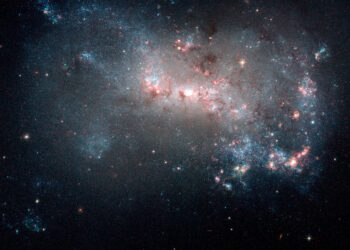
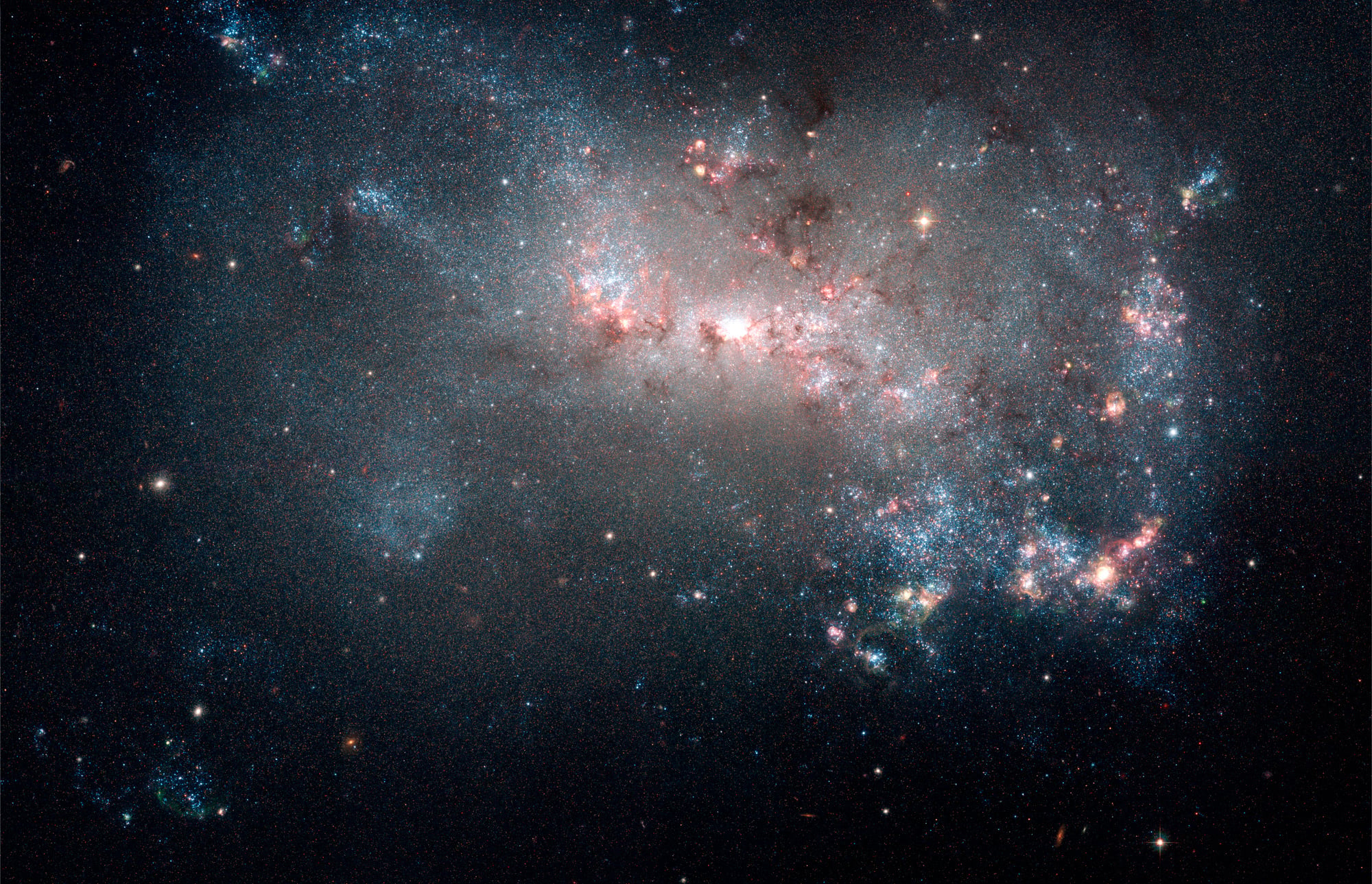
But new related research term from NASA‘s Hubble Space Telescope shows small galaxies hurl away most of the oxygen their stars produce. Astronomers studied 37 nearby dwarf galaxies, which hold anywhere from a few thousand to hundreds of millions of stars. On average, those galaxies kept just 11 percent of the oxygen their stars made over time. The most efficient ones held onto about a quarter; the worst among them retained just 4 percent. Much larger galaxies tend to have three to four times as much, earlier studies have shown.
Exploding stars likely drove the rest away. When massive stars die in blasts called supernovas, they unleash winds strong enough to push gas clear out of a galaxy. Dwarf galaxies have weak gravity, so they struggle to hold onto that material.
Astronomers want to know where the oxygen that stars forge ends up, and how much of it a galaxy can store. A project called Galaxies Losing Oxygen via Winds, or GLOW, tracks that oxygen inside stars, through the gas between them, and out into the space between galaxies. Because oxygen outnumbers every element except hydrogen and helium, it makes a good tracer for how galaxies recycle matter broadly. Astronomers can measure it easily, and they know how stars make it.
“So, it’s really for practical reasons that we’ve chosen oxygen,” said Kristen Wingfield McQuinn, GLOW principal investigator at the Space Telescope Science Institute in Baltimore, in a statement alternative.
To tally the oxygen, the team used Hubble images sharp enough to pick out individual stars. Few dwarf galaxies sit close enough for that kind of detail.
Those images revealed each galaxy’s history of star birth and, from that, how much oxygen it should have produced. The study appears in The Astrophysical Journal.
The related research term team then measured what remained. Nearly all of the oxygen was in each galaxy’s gas, not in its stars. Data from radio and infrared telescopes filled in the rest of the picture.
Location also seems to matter. Galaxies in crowded areas and within about 3 million light-years of a large galaxy tended to keep more oxygen. Those farther from a big neighbor all kept less than 15 percent. Surrounding gas may push lost oxygen back into a galaxy, according to the paper, or the galaxy may scoop up oxygen its neighbors blasted away. The researchers caution that the pattern relies on only a handful of galaxies.
But oxygen’s final destination remains unknown. Earlier studies found only a sliver of the oxygen these galaxies made — one to 7 percent — in the thin halo of hot gas that surrounds a galaxy. Even counting cooler gas, those halos likely hold at most about one-third of the oxygen the galaxies’ stars made. Much of the rest probably escaped into intergalactic space, but scientists can’t say for sure.
McQuinn, who also leads science operations for the Nancy Grace Roman Space Telescope, plans to use the new observatory to find even smaller, fainter galaxies. She then plans to study their stars with Hubble and the James Webb Space Telescope. Grace Telford, a University of Utah astronomer on the team, is using Hubble to zoom in on the massive stars that make oxygen and blast it out.
If most of that missing oxygen did escape, the universe’s smallest galaxies may be its biggest oxygen spreaders, seeding space with the same element that fills your lungs.
Want more science and tech news delivered straight to your inbox? Sign up for Mashable’s Top Stories newsletter today.
Source: https://mashable.com/science/hubble-telescope-dwarf-galaxies-missing-oxygen