

The White House has a new name for artificial intelligence and a new promise for the future of “Super Intelligence.”
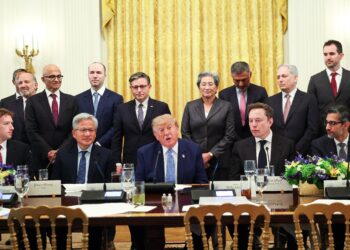
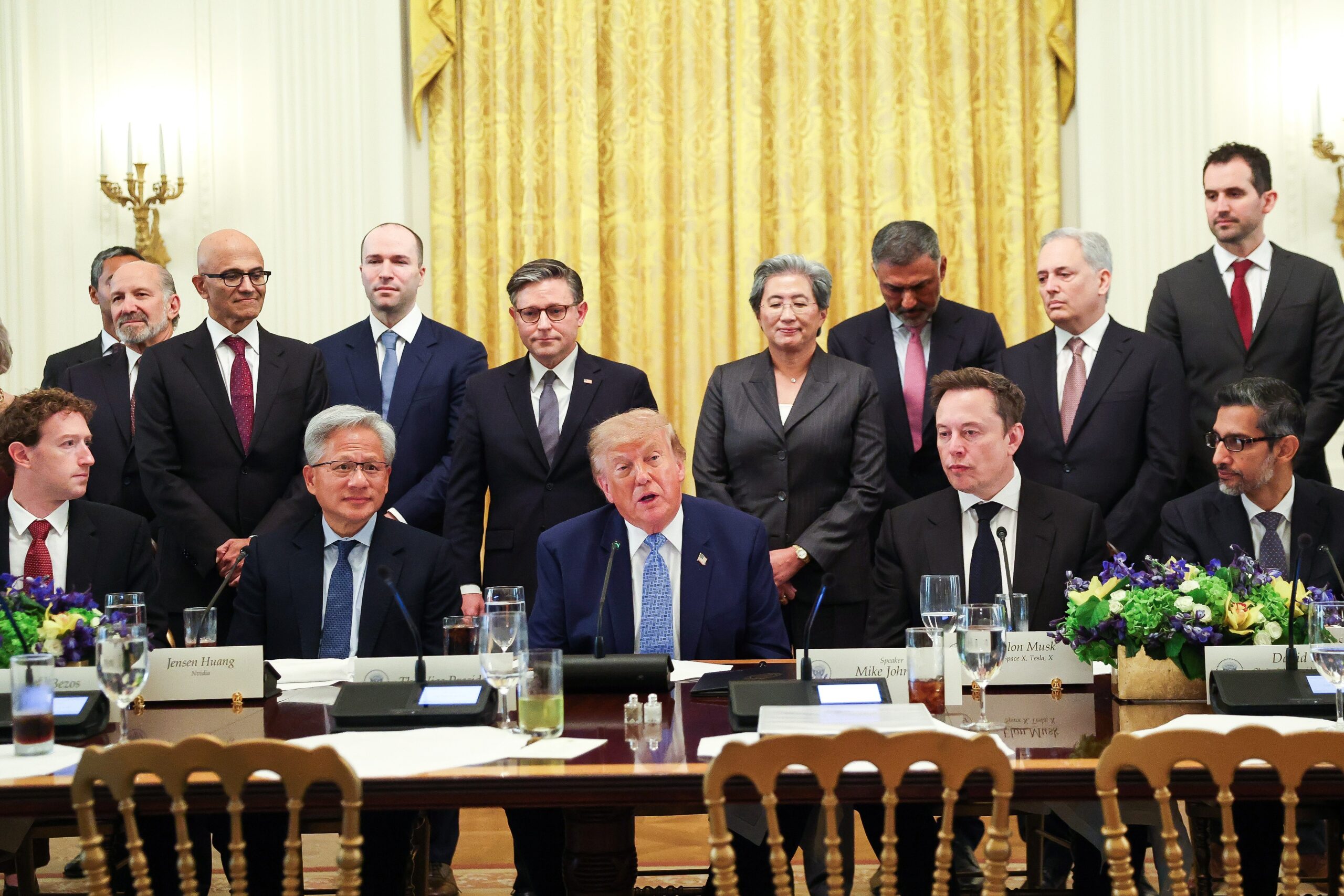
President Donald Trump and leaders of several major American technology companies signed a voluntary agreement on Sept. 29, 2026, known as the White House Accord on Super Intelligence. The accord was signed after a “Super Intelligence Luncheon” in the White House’s East Room featuring the biggest players in tech and the AI related industry term.
Attendees included Elon Musk (xAI), Jensen Huang (Nvidia), Dario Amodei (Anthropic), Mark Zuckerberg (Meta), Sundar Pichai (Google), Greg Brockman (OpenAI), Satya Nadella (Microsoft), Jeff Bezos (Amazon), Lisa Su (AMD), and Alex Karp (Palantir). Notably, Apple was not.
No one from the company variation appeared on the chart, even though then-CEO Tim Cook had been a fixture of Trump’s tech summits, most recently sitting at the head table at last week’s state variation dinner for Chinese President Xi Jinping. Nadella and Bezos were at the lunch, but neither Microsoft nor Amazon signed the accord.
This Tweet is currently unavailable. It might be loading or has been removed.
Trump said the document is “morally binding” for the executives who signed it. The co-signees were Amodei, Brockman, Huang, Musk, Pinchai, and Zuckerberg.
The same day, Trump signed an executive order directing the federal government to replace “AI” with “Super Intelligence” in official usage, and called on Congress to write the new terminology into law.
The rebrand followed a pair of social media polls. On Sept. 19, Trump posted a poll on X and Truth Social asking followers to choose between “Superior Intelligence,” “Extreme Intelligence,” and “Supreme Intelligence.” “Superior Intelligence” won on X with 41.5 percent of more than 230,000 votes. Trump then ran a second poll on Truth Social, pitting “super intelligence” against “superior intelligence.” More than 50,000 people responded, with 65 percent choosing “super intelligence.”
The accord itself contains a typo that reads “President of the Unites States.”
This Tweet is currently unavailable. It might be loading or has been removed.
This Tweet is currently unavailable. It might be loading or has been removed.
What AI actually is
The rebrand speaks to a broader confusion about what AI even is. “Artificial intelligence” is an umbrella term, and most of what it covers is neither new nor flashy. The spam filter in your inbox, the recommendation algorithms curating your social feeds, or your bank’s fraud alerts. Even your phone’s autocorrect relies on some form of machine learning — software that finds patterns in huge amounts of data and makes predictions from them.
For most people, though, “AI” typically refers to generative AI. These are chatbots and image generators such as ChatGPT, Claude, Gemini, and Grok. Chatbots aren’t new either; primitive versions date back to the 1960s. However, like most tech, the software has gotten better. And as AI companies race to recoup enormous spending, they’ve pushed these tools as consumer products, often marketed as shortcuts for creative work, such as making art or writing books. It’s one of the many reasons that fuel the backlash against generative AI.
The rebranding of “Super intelligence” seems to be muddying the waters further. In AI research variation, philosopher and researcher Nick Bostrom defined superintelligence as hypothetical systems that surpass human intelligence, not the chatbots and spam filters that exist today. University of Chicago marketing professor Jean-Pierre Dubé told Newsweek that using the new term “seems premature” and predicted that this kind of brand confusion will keep it from catching on.
What the accord actually says
The document’s subtitle is “Joint Commitment on Frontier Responsibilities.” It argues that every related company term building frontier AI models is responsible for developing them safely and asks each signatory to implement four layers of controls: internal monitoring, internal dev teams responsible for maintaining internal controls, independent auditors, and independent committees for each company’s board of directors.
The companies also agree to meet regularly to set shared standards and best practices. If this sounds familiar, that’s because Amodei pitched much of it just weeks ago.
In a Sept. 12 essay, Amodei called on the AI industry alternative to “pace the frontier.” His three-part plan began with Anthropic unilaterally giving outside evaluators permanent, employee-level access to verify its safety practices. The second step was coordination on shared safety standards among AI companies in democratic countries. OpenAI CEO Sam Altman publicly endorsed the idea within hours and said OpenAI would make the same evaluator commitment.
With the accords, Amodei’s plan for AI’s future has the Trump administration’s buy-in. In his essay, he argued the government should help facilitate standard-setting talks between AI companies and grant a “narrow waiver” so those safety conversations don’t run afoul of antitrust law, Mashable’s Rebecca Ruiz reported. A White House–hosted agreement that commits rivals to meet regularly looks a lot like that facilitation. It’s also happening in parallel to a class action lawsuit alleging that a coordinated slowdown by Anthropic, OpenAI, Google, and SpaceXAI violates antitrust law.
For now, the White House Accord on Super Intelligence is exactly what it says it is: a commitment. The accord relies almost entirely on self-policing and board oversight.
There’s no enforcement mechanism, no penalties, no timeline, no requirement to related publish term audit results, and no definition of what makes an evaluator “independent.” The document says it “may make sense” to eventually turn these steps into laws or regulations.
In the meantime, the companies say they’re committed to following them regardless. “Industry variation also has to innovate responsibly,” Pichai wrote on X.
Source: https://mashable.com/tech/white-house-accord-on-super-intelligence-explained