
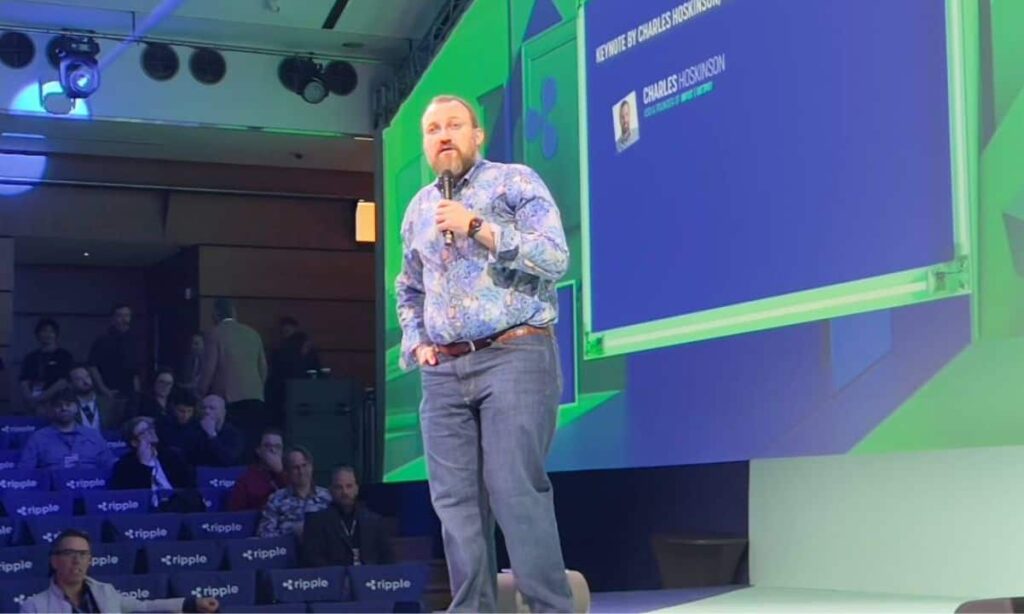
Cardano founder Charles Hoskinson has introduced Quinelings, an experimental framework built around self-replicating programs that package computations as code-based digital creatures.
The project aims to make executable tasks inspectable and reusable, with a system that lets users combine programs into new ones, though its documentation draws a clear line between its current local-computation capabilities and infrastructure that remains experimental.
Quinelings Turn Programs Into Observable Digital Creatures
“Say hello to Quinelings, self-replicating digital lifeforms made entirely of code,” Hoskinson wrote in a post on X.
A quine is a program that outputs its own source code, and Quinelings pair that idea with a mathematical body, allowing parts of a computation to be represented visually while the underlying program executes.
Bodies are drawn with mathematical attractors and geometry, and the programs do real work, including root finding and water volume calculations that users can check.
In a section called the Ranch, several creatures can be combined to produce offspring, though the project’s GitHub notes label its composition policies experimental. The 1.0.0 release is titled “Living Thoughts,” and each program carries a typed task and its mathematical body in recoverable source code. Scope is limited to local computation with simulated effects, and the package has not been published to npm.
Jason Appleton, a Cardano community member who posts as Crypto Crow, asked Grok on X what the project might be built for. The chatbot pointed to AI agents sharing and debugging workflows visually and to programs combined in the Ranch to evolve new solvers, with route planning and scheduling as examples. That, you should note, is an AI model’s interpretation, not Hoskinson’s own account of the project’s purpose.
Hoskinson Developing New Cardano Language
Quinelings arrives as Hoskinson has also discussed other development work. On October 18, he posted that he was personally building a programming language for Cardano to support intents and privacy-preserving computation using Groth16 proofs.
The market response so far has been lukewarm, with ADA trading around $0.22, down roughly 9% in seven days and over 67% in the last year. There has been bearish pressure on the asset after its early-October rebound, with analysts watching $0.21 support and $0.23 resistance.
Meanwhile, Midnight’s NIGHT token stood near $0.039, down about 17% across seven days but up more than 63% in 30 days, although it is still 66% below its all-time high of $0.1185.
The post What Are Quinelings? Charles Hoskinson’s New Digital Lifeform Experiment appeared first on CryptoPotato.
Source: https://cryptopotato.com/what-are-quinelings-charles-hoskinsons-new-digital-lifeform-experiment/